
Home / Research Articles / How to Reconstitute Research Peptides: A Step-by-Step Tutorial
How to Reconstitute Research Peptides: A Step-by-Step Tutorial
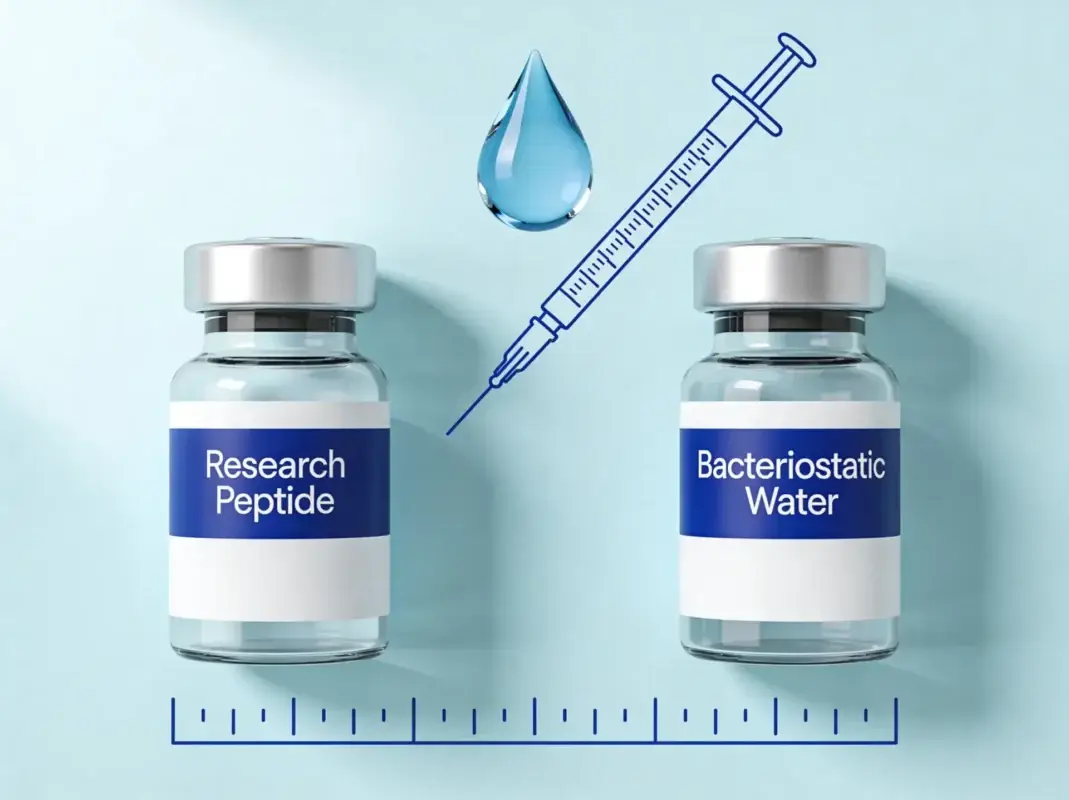
Key Takeaways
- Research peptide reconstitution requires bacteriostatic water (BAC water), aseptic technique, and accurate concentration math based on the specific peptide's mass and molecular weight.
- The standard technique is to inject bacteriostatic water down the inner wall of the vial rather than directly onto the lyophilized powder, then swirl gently until fully dissolved — never shake.
- Concentration is calculated as mass divided by volume: a 5 mg vial reconstituted with 2 mL of BAC water yields 2.5 mg/mL.
- Once reconstituted, peptides should be stored at 2–8°C and used within 28 days; freeze-thaw cycles should be avoided.
- Common errors include direct-onto-powder injection (which causes foaming), inadequate dissolution time, using sterile water instead of bacteriostatic water for multi-dose research vials, and miscalcul
Reconstitution is the step that converts a research peptide from a lyophilized (freeze-dried) powder into a working aqueous solution. Done correctly, it produces a stable, accurately-measured solution that supports reproducible research. Done incorrectly, it introduces variability that compromises every downstream measurement — wrong concentration, contamination, foaming-induced peptide loss, or degradation from poor storage.
This tutorial covers the standard reconstitution procedure for lyophilized research peptides, the concentration math that researchers need to get right, the storage requirements that protect peptide integrity, and the common errors that derail reconstitution most often. The procedure applies broadly across the peptide research catalog — BPC-157, Semaglutide, CJC-1295, Ipamorelin, and other lyophilized research peptides follow the same fundamental technique, with the math adjusted for each compound’s specific mass and molecular weight.
What You Need Before Starting
A reconstitution session requires the following materials and conditions:
The lyophilized peptide vial. Inspect before starting. The powder should appear as a clean white or off-white cake or pellet without discoloration. Cloudiness, yellowing, or visible particulates indicate degradation, and the vial should not be used.
Bacteriostatic water (BAC water). Bacteriostatic water is sterile water containing 0.9% benzyl alcohol as a preservative, formulated for multi-dose vial use. The benzyl alcohol inhibits microbial growth in the vial across multiple withdrawals, which is essential for research peptides that will be drawn from the same vial across multiple sessions. Sterile water without preservative is not equivalent for multi-dose research applications [Ref. 2]. Kinetic Compounds carries bacteriostatic water formulated to pharmaceutical standards for this purpose.
A clean, sterile syringe and needle. Single-use disposable syringes appropriate for the working volume. Insulin syringes (0.5 mL or 1 mL) are commonly used for small-volume research work because their fine graduations support accurate measurement.
Alcohol swabs. For wiping the rubber stoppers of both vials before each insertion to maintain aseptic technique.
A clean work surface. Wiped with isopropyl alcohol or equivalent before starting. Reconstitution should be performed in a draft-free area away from sources of contamination.
Step-by-Step Procedure
The standard technique has six steps. The procedure is the same whether the peptide is BPC-157, Semaglutide, CJC-1295, or any other lyophilized research peptide — only the math changes.
Step 1: Calculate the target concentration
Before drawing any liquid, decide the final concentration you want and calculate the volume of BAC water needed. The formula is:
Volume (mL) = Peptide mass (mg) ÷ Target concentration (mg/mL)
For example, a 5 mg vial of peptide at a target concentration of 2.5 mg/mL requires 2 mL of BAC water (5 ÷ 2.5 = 2). The same vial at 5 mg/mL requires 1 mL (5 ÷ 5 = 1).
Researchers can verify this calculation against our peptide reconstitution calculator, which handles the math automatically for common peptides and concentrations.
Step 2: Prepare both vials
Wipe the rubber stoppers of both the peptide vial and the BAC water vial with alcohol swabs. Allow the alcohol to dry — this takes 10–15 seconds and is part of the aseptic technique, not an optional step.
Step 3: Draw the bacteriostatic water
Insert the syringe needle into the BAC water vial, invert the vial, and slowly draw the calculated volume of BAC water into the syringe. Verify the volume against the syringe graduations before withdrawing the needle.
Step 4: Inject down the inner wall
This is the most important step technically. Insert the needle into the peptide vial and angle it so the needle tip rests against the inner wall of the vial rather than pointing directly at the lyophilized powder cake. Slowly inject the BAC water so it runs down the wall of the vial onto the powder — not directly onto the powder.
This technique matters because direct injection onto lyophilized peptide powder can cause foaming, which physically damages the peptide structure and can result in measurable peptide loss [Ref. 1]. The slow wall-injection technique allows the BAC water to gently dissolve the powder without creating excessive turbulence.
Step 5: Swirl gently — never shake
Withdraw the syringe. Gently swirl the vial in a slow circular motion for 15–30 seconds, or until the powder is fully dissolved. The solution should become clear or very lightly translucent depending on the specific peptide.
Do not shake the vial. Shaking introduces air bubbles, accelerates oxidative degradation, and can damage the peptide structure. Gentle swirling is sufficient for dissolution; vigorous agitation is counterproductive.
If the powder does not fully dissolve within 30 seconds, let the vial sit at room temperature for 1–2 minutes and swirl again. Some peptides take slightly longer to fully dissolve than others.
Step 6: Inspect and store
Once dissolved, inspect the reconstituted solution visually. It should be clear and free of particulates. Cloudiness, discoloration, or visible particles indicate degradation or contamination, and the vial should be discarded.
Label the vial with the date of reconstitution and the final concentration. This is critical for research record-keeping and for monitoring the 28-day in-use window.
Move the reconstituted vial to refrigeration (2–8°C) for storage.
Concentration Math, in Detail
The basic formula — concentration equals mass divided by volume — sounds simple, but the math has practical implications that affect every measurement downstream.
Example 1: BPC-157, 5 mg vial. A 5 mg vial of BPC-157 reconstituted with 2 mL of BAC water yields 2.5 mg/mL. To withdraw 250 μg, the researcher draws 0.1 mL (since 0.1 mL × 2.5 mg/mL = 0.25 mg = 250 μg). On an insulin syringe graduated in “units” (where 100 units = 1 mL), 0.1 mL = 10 units.
Example 2: Semaglutide, 5 mg vial. A 5 mg vial of Semaglutide reconstituted with 2 mL of BAC water also yields 2.5 mg/mL. The volume-to-mass relationships are identical because the math is concentration-based, not compound-based — but the molar concentrations differ because Semaglutide and BPC-157 have very different molecular weights (Semaglutide ~4,113 g/mol, BPC-157 ~1,419 g/mol).
Example 3: Ipamorelin, 10 mg vial at 5 mg/mL. A 10 mg vial reconstituted with 2 mL yields 5 mg/mL. To withdraw 500 μg, the researcher draws 0.1 mL.
Example 4: Larger volumes, lower concentrations. A 5 mg vial reconstituted with 5 mL of BAC water yields 1 mg/mL — a more dilute working solution, easier to measure small doses from, but with the trade-off that 5 mL must be used within the 28-day window.
The reconstitution calculator at kineticcompounds.com/peptide-reconstitution-calculator/ handles these calculations for all common peptides and target concentrations.
Storage and Handling After Reconstitution
Once reconstituted, peptide stability depends on storage conditions [Ref. 4].
Temperature. Refrigerate at 2–8°C. Reconstituted peptides should not be left at room temperature beyond brief working sessions.
Light. Protect from light. Most refrigerators provide adequate light protection, but vials kept in clear or unsleeved storage may benefit from being placed inside an opaque container.
Time. Use within 28 days of reconstitution. The benzyl alcohol in BAC water inhibits microbial growth across this window; beyond it, microbial growth and peptide degradation both become risks.
Freeze-thaw avoidance. Repeated freeze-thaw cycles degrade peptide integrity [Ref. 3]. Researchers planning to use a reconstituted vial across multiple sessions should consider aliquoting the working stock into smaller volumes immediately after reconstitution. This allows individual aliquots to be frozen and thawed only once each, rather than subjecting the entire working stock to repeated cycles.
Lyophilized storage. Unreconstituted lyophilized vials remain stable at -20°C protected from light for 24 months or longer. Reconstitution is a one-way change; once reconstituted, the 28-day window applies regardless of refrigeration.
For full storage protocols across the broader research peptide catalog, see our storage and reconstitution guide.
Common Errors and Troubleshooting
Several errors recur across reconstitution sessions. Each has a specific cause and a specific remedy.
Error: The peptide solution is foaming. Cause: BAC water was injected directly onto the lyophilized powder, or the vial was shaken rather than swirled. Remedy: For the next batch, inject down the inner wall and swirl gently. For the current batch, let the vial sit until foam subsides before measuring withdrawal volume — measuring while foaming gives inaccurate volume readings.
Error: The powder is not fully dissolving. Cause: Insufficient dissolution time, or unusual peptide stability characteristics for the specific compound. Remedy: Let the vial sit at room temperature for 2–5 minutes and swirl again. Most lyophilized research peptides dissolve fully within 1–2 minutes; longer-dissolving compounds need more patience, not more agitation.
Error: The reconstituted solution is cloudy. Cause: Either contamination, peptide degradation, or excess particulate matter in the lyophilized powder. Remedy: Discard the vial. Cloudy solutions should not be used in research — the cause cannot be reliably identified from visual inspection alone, and the solution’s integrity is compromised regardless.
Error: Concentration is incorrect after dilution. Cause: Math error in mass-to-volume calculation, or measurement error during BAC water draw. Remedy: Recalculate before the next reconstitution, and verify against the reconstitution calculator. Volume measurement errors of even small amounts (e.g., 1.8 mL instead of 2.0 mL) shift final concentration by significant percentages.
Error: Using sterile water instead of BAC water for multi-dose vials. Cause: Mistaking sterile water for an equivalent product. Remedy: For any peptide vial that will be drawn from across multiple sessions, use bacteriostatic water. Sterile water without preservative can be used for single-session, single-withdrawal research, but does not support multi-dose use [Ref. 2].
Error: Peptide stability is shorter than expected. Cause: Storage above 2–8°C, exposure to light, or freeze-thaw cycling. Remedy: Move to proper refrigeration immediately and reassess the in-use window. If freeze-thaw exposure occurred, consider the working stock compromised for precision research and reconstitute fresh.
The aseptic technique principles in this tutorial follow general pharmaceutical compounding standards [Ref. 5], adapted for research-grade peptide work where the goal is reproducible measurement rather than therapeutic preparation.
Sourcing Research-Grade Peptides
Every reconstitution procedure assumes the input is verified peptide of known purity and identity. A Certificate of Analysis specifying HPLC purity, mass spectrometry identity confirmation, and peptide content is the foundation that makes the math meaningful.
Kinetic Compounds tests every batch of every peptide through Janoshik Analytical, an independent third-party laboratory. Current batch reports are published on each product page. Our broader testing methodology is documented on our lab testing and COA page, and the principles of reading a research peptide COA are covered in detail in our reading a Certificate of Analysis article.
For bacteriostatic water, aseptic technique standards apply to the BAC water itself: the product should be pharmaceutical-grade, sealed, and within its labeled stability window. Bacteriostatic water from non-pharmaceutical sources, or BAC water that has been opened beyond its in-use window, should not be used for research peptide reconstitution.
Reconstituting research peptides regularly? Our peptide reconstitution calculator handles the math for any peptide and target concentration — and every product in our research peptide catalog ships with a third-party Certificate of Analysis published on the product page.
Related Peptides
Related peptides will load here via PHP snippet.
Available for Research
Research Tools
Quality Promise
very batch independently tested by Janoshik Analytical. 98% purity minimum.
Frequently Asked Questions
What is the difference between bacteriostatic water and sterile water?
<p>Bacteriostatic water contains 0.9% benzyl alcohol as a preservative, which inhibits microbial growth across multiple vial withdrawals over a 28-day window. Sterile water without preservative is single-use only — once the vial is breached, microbial growth becomes a risk. For research peptides used across multiple sessions from the same vial, bacteriostatic water is the appropriate choice.</p>
Can I use tap water or distilled water to reconstitute peptides?
<p>No. Tap water contains microorganisms, minerals, and other contaminants that compromise peptide integrity and introduce variability into research measurements. Distilled water lacks preservative and is not formulated for pharmaceutical-grade reconstitution. Use bacteriostatic water specifically formulated for research peptide reconstitution.</p>
How long does a reconstituted peptide vial last?
<p>Typically 28 days when stored at 2–8°C and protected from light. The benzyl alcohol in bacteriostatic water inhibits microbial growth across this window. Beyond 28 days, both microbial growth and peptide degradation become risks. Some peptides may have shorter or longer stability windows depending on their chemistry — always check the product page or COA for compound-specific information.</p>
What concentration should I reconstitute to?
<p>This depends on the research protocol — there is no universal answer. Higher concentrations (e.g., 5 mg/mL) reduce the working volume needed per dose but make small-volume measurement harder. Lower concentrations (e.g., 1 mg/mL) make small-volume measurement easier but require larger volumes per dose and use more BAC water. Most research protocols target 2–5 mg/mL as a balance. Our reconstitution calculator supports any target concentration.</p>
Why shouldn't I shake the vial?
<p>Shaking introduces air bubbles, accelerates oxidative degradation of the peptide, and can cause physical damage to the peptide structure through cavitation. Gentle swirling produces full dissolution without these problems. The instinct to shake comes from kitchen mixing — pharmaceutical-grade reconstitution uses gentler technique because peptides are more fragile than the substances people typically mix in everyday life.</p>
What do I do if I accidentally inject directly onto the powder and it foams?
<p>Let the vial sit undisturbed for 5–10 minutes for the foam to subside. The peptide is likely still usable, but visually verify that the dissolved solution is clear and free of particulates before measuring volumes. If you can measure withdrawal volumes accurately and the solution looks normal, proceed. If the foaming is severe or persistent, consider the vial compromised for precision research.</p>
Where can I verify my reconstitution math?
<p>Kinetic Compounds maintains a peptide reconstitution calculator at kineticcompounds.com/peptide-reconstitution-calculator/. The calculator supports all common peptides and target concentrations.</p>
References
- "Instability, stabilization, and formulation of liquid protein pharmaceuticals." International Journal of Pharmaceutics, 185(2):129-188. — Wang W (1999).
- "Antimicrobial Preservatives for Protein and Peptide Formulations: An Overview." Pharmaceutics, 15(2):563. — Stroppel L, Schultz-Fademrecht T, Cebulla M, Blech M, Marhöfer RJ, Selzer PM, Garidel P (2023).
- "Instability, stabilization, and formulation of liquid protein pharmaceuticals." International Journal of Pharmaceutics, 185(2):129-188. — Wang W (1999).
- "Stability of protein pharmaceuticals: an update." Pharmaceutical Research, 27(4):544-575. — Manning MC, Chou DK, Murphy BM, Payne RW, Katayama DS (2010).
- USP <797>: Pharmaceutical Compounding — Sterile Preparations. — United States Pharmacopeia.
Continue Reading
For Research Use Only Products described on this site are intended for laboratory research purposes only. They are not approved by Health Canada for human consumption, diagnosis, treatment, or prevention of any medical condition.